The software behind your inventory optimisation.
EazyStock computes forecasts, stock parameters and order proposals for thousands of articles every night. Your ERP stays the leading system, and your purchasing only decides the exceptions.
A working day in five stations.
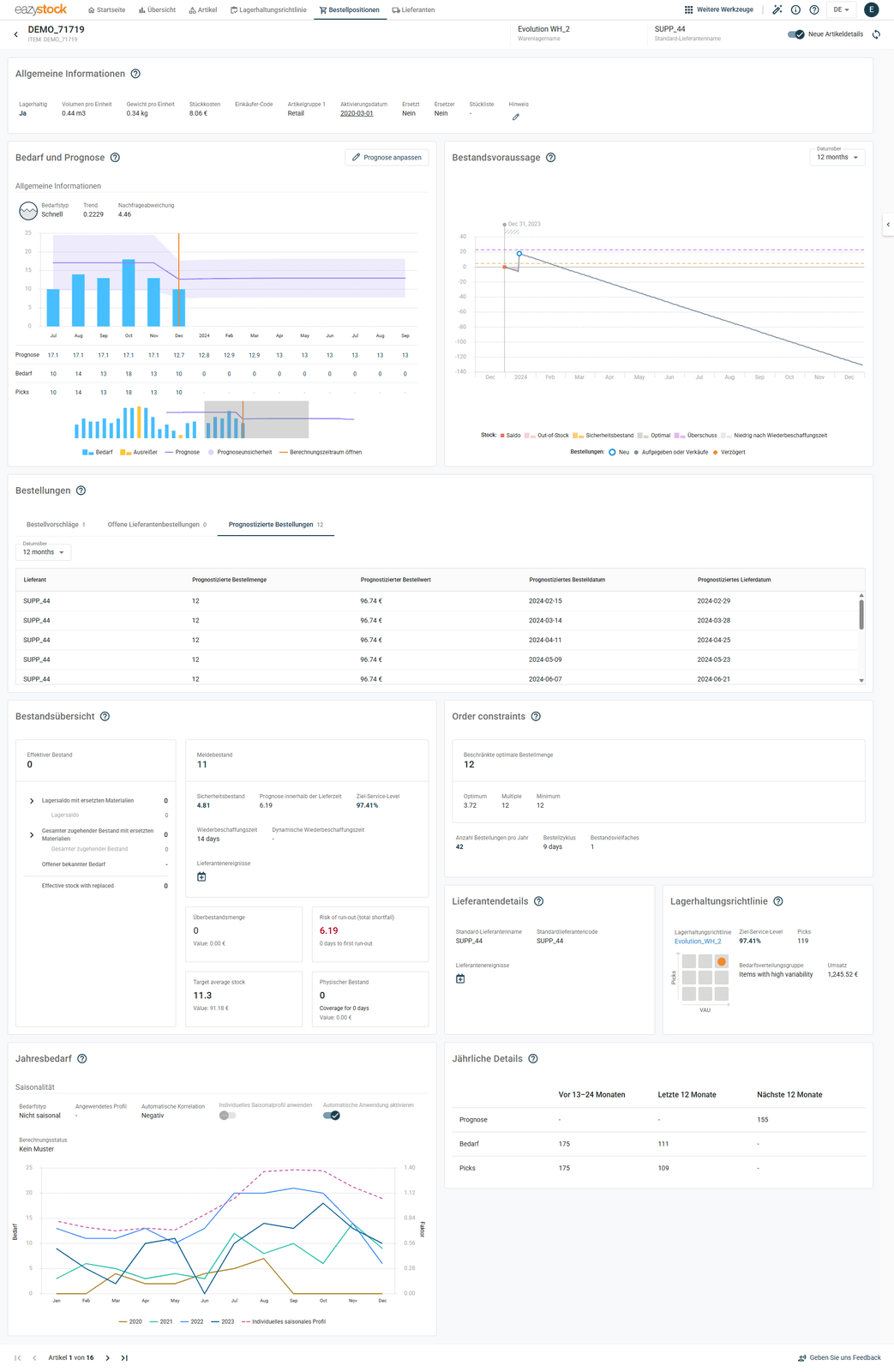
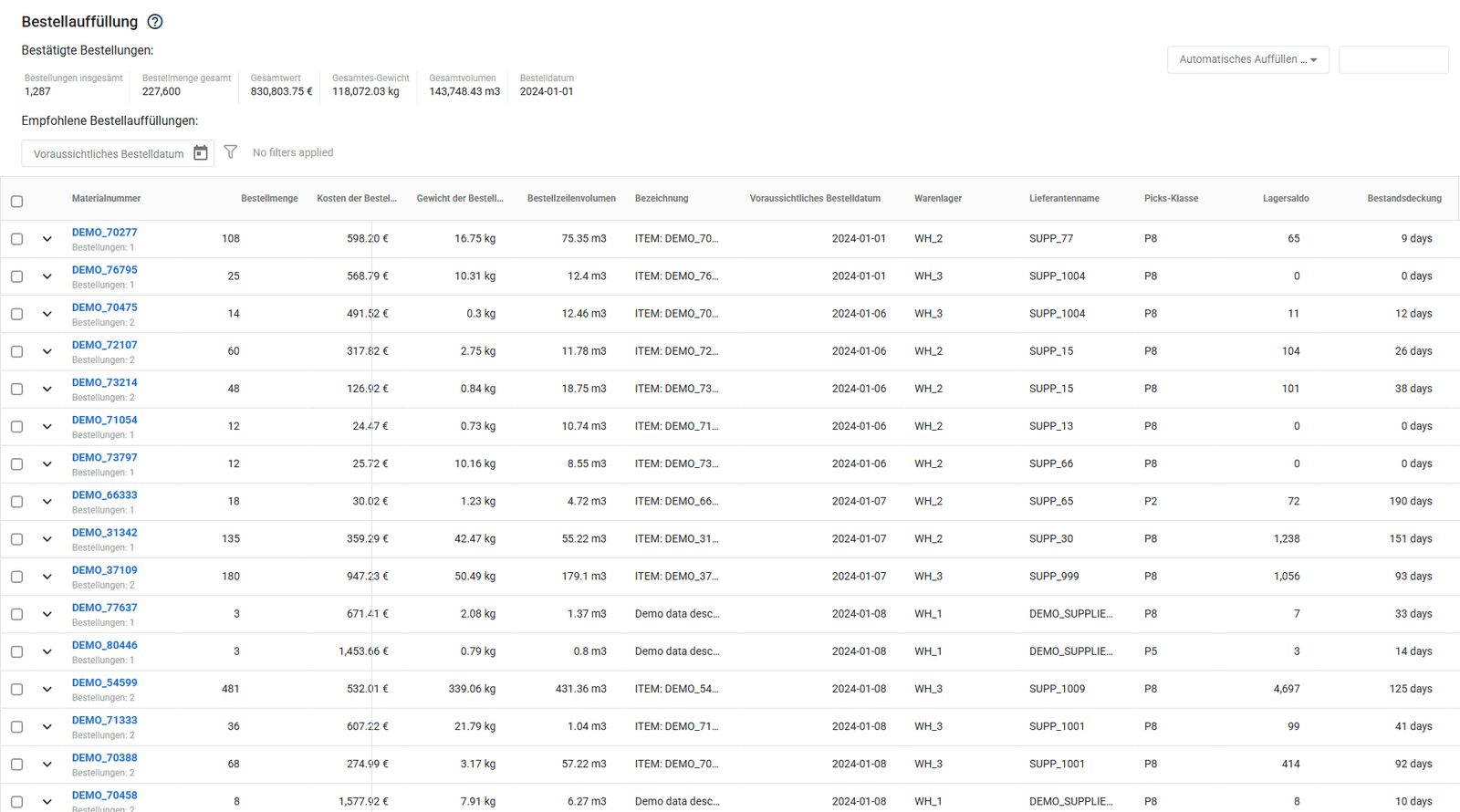
Real views from EazyStock Evolution, no marketing mockups. Click your way through.
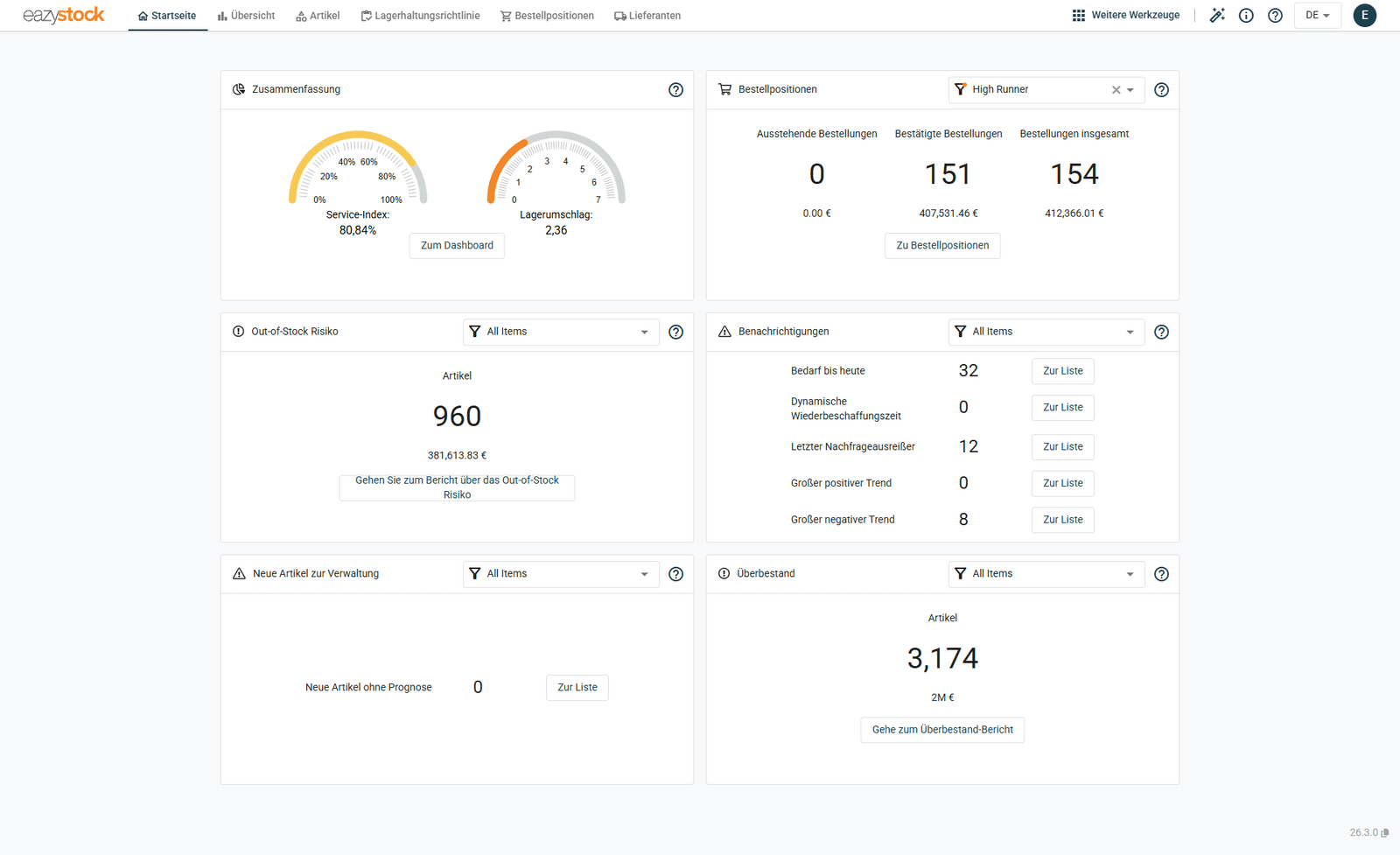
Home: The morning begins with a glance: service index, out-of-stock risk, excess stock and all alerts on one screen. Management by exception instead of an article list.
What EazyStock computes for you every night.
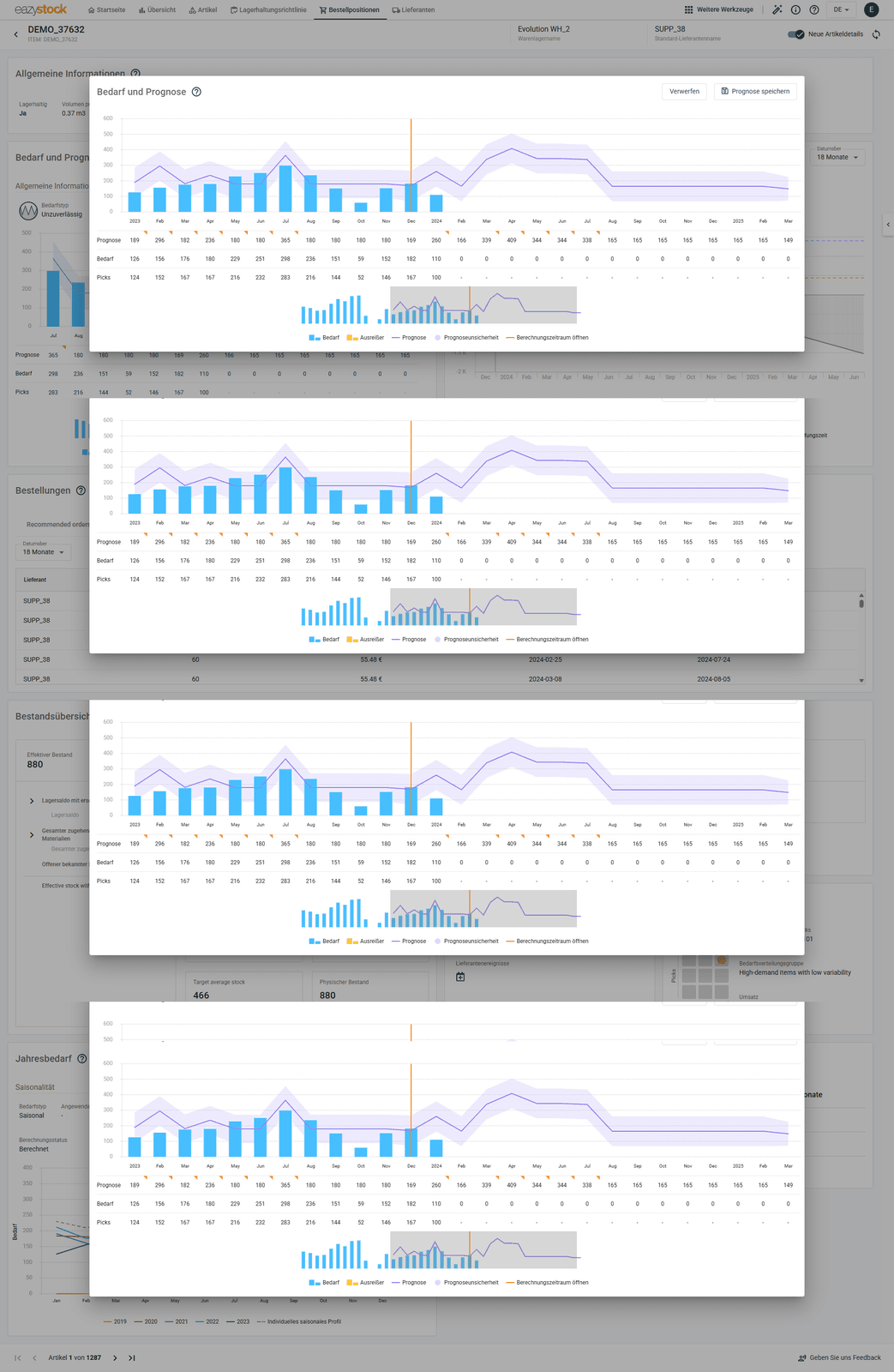
Forecasts
Over 97% availability across nearly 43,000 products
Targets
−38% inventory at 95% service level
Ordering
−75% time spent in purchasing
Constraints
99% on-time, complete orders
Production
−20% inventory at 99% service level
Exceptions
98% fewer stockouts
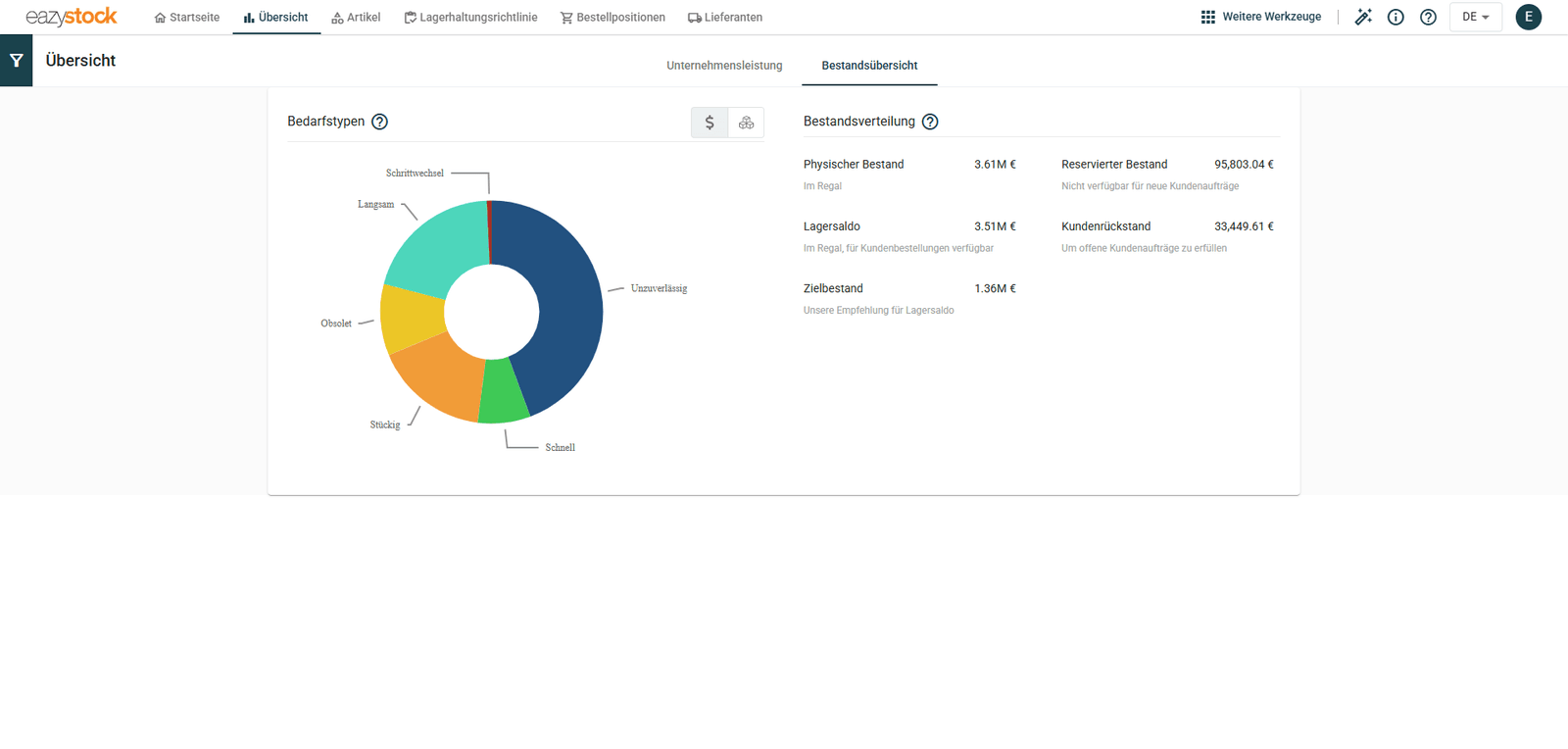
And more from the product.
Your ERP? Probably already connected.
Behind every EazyStock rollout stands EazyERP, our interface platform for fast ERP connections: ready-made connectors for common systems, new connections in days instead of months, weclapp even via wizard in minutes. The exchange runs nightly and monitored, including for on-premises systems without a public interface.














"Our ERP can do that too, right?"
Partly. Your ERP can order, and it should keep doing so. What it lacks is the computation before that: forecasts per article, simulated targets, nightly-updated parameters. The difference in detail:
That's why EazyStock doesn't replace your ERP, it adds to it: the ERP stays the leading system, and ordering continues there.
Where EazyStock is strong. And where not.
Strong everywhere many articles with recurring demand have to stay available. Six starting situations that fit well, with results from real projects:
- Technical wholesale
- Spare-parts trade & after sales
- E-commerce
- Chain & multi-warehouse retail
- Series manufacturing
- Make-to-order manufacturing
The approach isn't designed for extremely short lifecycles or highly perishable goods:
- Highly perishable goods (fruit, vegetables, fresh meat)
- Fast fashion: short lifecycles, hardly any recurring articles
- Process industry (chemicals, gas processing, steel)
- Special-purpose machinery with a low share of common parts
From kickoff to go-live: the typical plan.
The fastest rollout was 8 days; 3 to 6 months is typical. Here's what a standard project over around 14 weeks looks like — the phases deliberately overlap:
Conception
Definition and interface workshops: survey processes, clarify data scope. Everything is written down in the concept document that defines the project scope.
Interface connection
Connection to your ERP via EazyERP. With a ready-made connector this phase shrinks to days, the lever behind the 8-day rollout.
Data import & validation
Your data flows through the interface, and integrity tests check it for consistency. This is where it shows what your master data really offers.
Configuration & tests
EazyStock is configured to your situation, following best practices from hundreds of projects. Workflows and functions are checked for consistency.
Training & adjustments
Your team runs through the procurement process with real live data, in two training rounds. Parameters are fine-tuned where needed.
Go-live & hypercare
Going live with close support. After that ongoing operation begins: support, check-ins and further development.
What does EazyStock do? What does Systempilot do?
EazyStock (Syncron)
Developer and solution provider: software development, configuration during the project, hosting and technical support for incidents. The platform is based on the enterprise solution Syncron Parts Planning, trusted by world brands like Siemens, CLAAS or JCB.
Systempilot
Sales and implementation partner: project management, interfaces and middleware via the Integration Accelerator™, first-level support and ongoing operation. A fixed point of contact, from the first workshop on.
Enterprise-grade security.
EazyStock runs on the Syncron platform and thus under the same security standards under which Caterpillar, Toyota and Harley-Davidson have their parts data processed. The most common question first: hosting is at Amazon Web Services in the EU, in the Dublin data centre.
Hosting in the EU
AWS Dublin (Ireland), GDPR-compliant with a data processing agreement. Production and development environments are strictly separated.
Certified and audited
ISO/IEC 27001:2022 and ISO/IEC 27017 for cloud security, SOC 1 and SOC 2 Type 2, TISAX. Plus regular third-party penetration tests.
Access and encryption
Multi-factor authentication, role-based access, audit logging. Data is encrypted in transit and at rest.
Operation and prevention
Redundant backups, DDoS protection, intrusion detection and documented incident-response processes with ongoing monitoring.
How does an EazyStock project run?
Michael Schnepf and Felix Kogler discuss how the rollout runs with us as a partner: from the first workshop through the connection to go-live. No script, just the two people you'll also talk to during the project.
"Systempilot helped us cut inventory by 38% by introducing different stocking strategies for equipment and spectacle lenses."
Does EazyStock fit your assortment?
We clarify that in a short intro call: your starting situation, your data and whether the solution fundamentally fits. After that you decide whether a potential analysis is the next step.
Frequently asked questions about EazyStock.
Is EazyStock an ERP system or an ERP replacement?
No. EazyStock connects to your ERP via an interface, e.g. SAP or Microsoft Business Central, and imports historical consumption, master data and open orders. The ERP stays the leading system where all data is maintained. In EazyStock you maintain nothing twice.
Our master data isn't good. Does it still work?
An inventory-optimisation system is only as good as its data. But EazyStock gets a lot out of little: it only needs basic stock data like inventory level, lead time and minimum order quantities, plus historical consumption and open supplier orders. In other words, data usually maintained in the ERP.
What about production?
EazyStock answers which articles you need when and in what quantity. Make-to-stock manufacturers get order proposals for which articles belong in stock in what quantity. Make-to-order manufacturers optimise the availability of components and assemblies to start customer orders faster.
What prerequisites do we need?
An ERP or inventory-management system where customer orders, supplier orders and article master data are maintained. Which system doesn't matter: it's enough if it can export data as CSV and import order proposals as CSV or XML. For many systems there are ready-made connectors.
What does EazyStock cost?
EazyStock is a SaaS product: hosting, maintenance, support and licence are covered by a monthly flat price, with us typically from around €1,000 per month. The price depends on the EazyStock version, the inventory value, the number of warehouses and the number of connected ERP systems. In the intro call you get a price indication right away.
Where is our data hosted?
At Amazon Web Services in the EU, in the Dublin (Ireland) data centre. Syncron is certified to ISO/IEC 27001:2022 and ISO/IEC 27017, audited to SOC 1 and SOC 2 Type 2, and GDPR-compliant including a data processing agreement. All certificates and policies are viewable in the public Syncron Trust Center (trust.syncron.com).
Are we too big or too small for it?
EazyStock targets the mid-market with thousands of articles for which Excel and static order proposals are no longer enough. Our smallest clients have around €500,000 in inventory. There's no upper limit: the platform is based on the enterprise solution Syncron Parts Planning, trusted by brands like Siemens, CLAAS or JCB.
As a rule of thumb, EazyStock pays off from around €1m in inventory through carrying costs alone. Adding time saved in purchasing, fewer lost sales and fewer rush orders, considerably earlier.
How long does the rollout take?
That depends on the scope: trade or manufacturing too, number of sites and ERP systems, whether a ready-made connector already exists and how much resource you can provide. The fastest rollout took 8 days; the average is 3–6 months.
How long do we commit for?
EazyStock contracts usually run for 1 year and can be cancelled up to 3 months before expiry.