
Cut inventory, stay in stock. Right inside pixi.
pixi keeps your warehouse running, from goods-in to dispatch. What's missing is the forward view: EazyStock computes forecasts and order proposals on your pixi data every night, with seasonal curves and peaks instead of fixed reorder points. Your purchasing keeps ordering from pixi.
Can pixi optimise inventory automatically?
Only to a limited extent. pixi generates order proposals when reorder or target stock is breached. You maintain both values per article and warehouse location by hand, and there's no forecast. An inventory optimisation like EazyStock closes that gap.
How does EazyStock get the pixi data?
Via the pixi API, cloud to cloud. An API access with read rights is enough; there's no installation or infrastructure on your side. Go-live in 2–4 weeks.
Does EazyStock replace pixi purchasing?
No, it adds to it: forecasts, up-to-date parameters, prioritised proposals. Ordering stays in pixi, as usual directly to the supplier.
Ever run into this in pixi?
Four points where pixi purchasing hits its limits. With links to pixi.eu so you can read up yourself.
You maintain reorder and target stock by hand.
Per article and per warehouse location, you set when pixi generates an order proposal and up to what level it tops up. As a maintenance aid, pixi shows the historical sell-through. With thousands of SKUs and several locations, that means: your values are as current as your last maintenance afternoon, and in e-commerce that's quickly a long time ago.
Purchasing features on pixi.eu ↗Historical sell-through isn't a forecast.
pixi shows you what was sold and filters proposals by target stock, open customer orders or stock coverage. All of it looks backwards. A forecast that projects trend and growth per article is not something you get. With fast-moving assortments that means: reordered too late or overstocked.
pixi purchasing whitepaper ↗The reorder point breaches too late.
An order is placed when the value is breached, i.e. reactively. But before Q4, or for goods with an eight-week lead time from the Far East, the right order moment is weeks before the shortage. A fixed reorder point knows neither season nor lead-time risk: it flags up once things are already tight.
Order proposals on pixi.eu ↗You plan promos and drops separately.
Ad campaign, newsletter wave, influencer post, product drop: the extra demand is in no reorder point because it's in no history. You plan it in Excel next to the system, and the proposals keep running at normal levels until the shop shows "sold out".
Order management on pixi.eu ↗Where does that lead for you?
Manual planning via reorder points is error-prone. We know the pattern from many intro calls in e-commerce:
Can it be done better? Of course: with EazyStock.
EazyStock computes on your pixi data and answers exactly the four problems above. Your team keeps ordering from pixi.
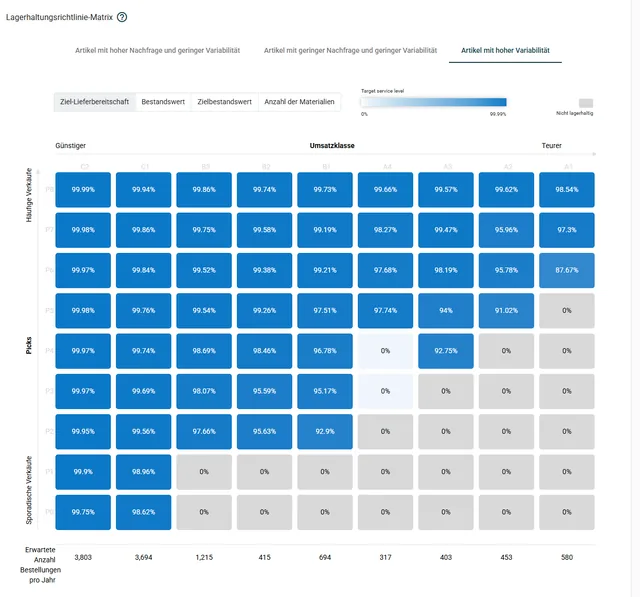
Up-to-date stock parameters.
Safety and reorder stock per article and location are recalculated every night, derived from your target supply capability. The maintenance afternoon is gone.
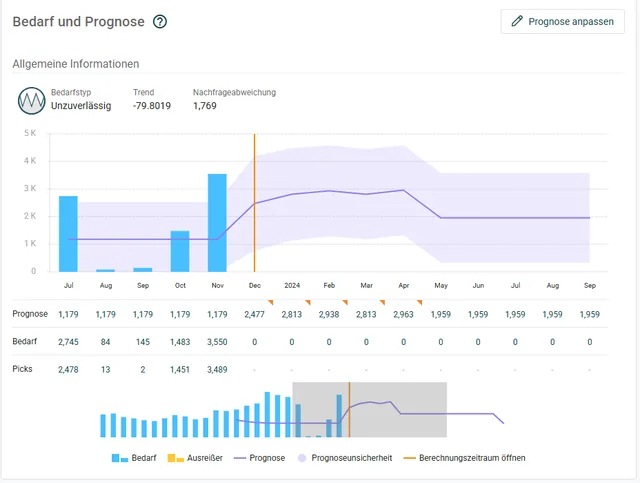
Real forecasts per article.
Trend, growth, outlier cleansing: EazyStock computes forwards instead of backwards and adapts when demand shifts.
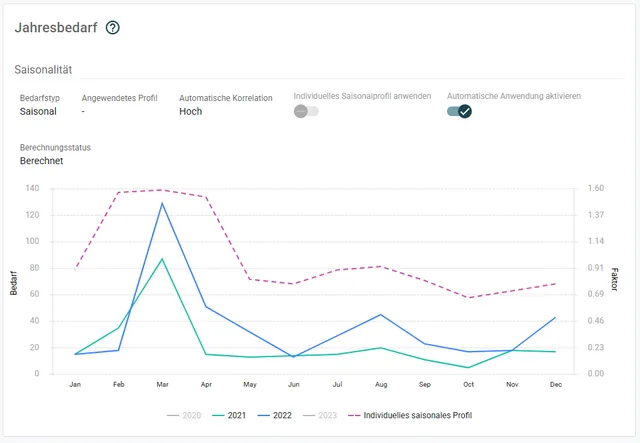
Ordered before it runs short.
Seasonal curves and lead times flow into the order timing. Q4 goods are ordered when they need to be, not when the reorder point breaches.
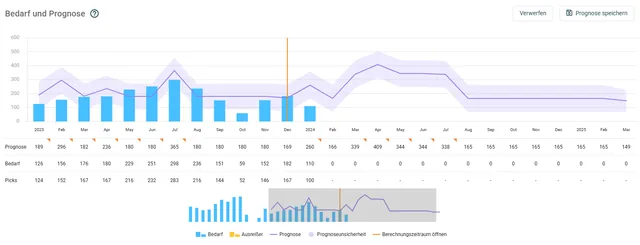
Campaign demand planned in.
Promo, drop or ads planned? You enter the expected extra demand as a forecast adjustment. The order proposals move with it before the shop shows "sold out".
Cloud to cloud via the pixi API.
pixi is cloud, our middleware EazyERP is cloud. There's no infrastructure in between on your side: the connector links both via the pixi API.
Create API access
You request an API access from pixi with read rights to articles, stock and orders. No installation, no infrastructure.
Your effort: approx. 30 minutes of admin timeMapping and test runs
We configure field mapping, location assignment and business logic and run test runs against your real data until the proposals fit your assortment.
Your effort: a few clarifying questions, no developer neededNightly operation
Every night, articles, sell-through and open orders flow to EazyStock. In the morning, prioritised order proposals are ready; ordering happens as usual from pixi to the supplier.
Your effort: none in regular operationOwn warehouses, fulfillers, retail stores: pixi keeps stock per location, and EazyStock plans them in a multi-warehouse model. The warehouse mapping with roles defines which location is planned and which only counts. A manifest prevents duplicate transactions, and we monitor the runs.
Behind it stands EazyERP, our middleware.
Field mapping to the EazyStock spec, value substitutions, warehouse mapping with roles, a quality gate against the run: what the connector does every night is configured instead of hard-coded, and traceable for every run.
“Friendly, fully committed, and they resolve every challenge promptly.”

Common questions about Descartes pixi and EazyStock.
How long does connecting pixi to EazyStock take?
The API access is requested in about 30 minutes. Then come data import, configuration of your business logic and test runs: expect 2–4 weeks to go-live, depending on data quality and assortment.
What do we need to do on our side?
Exactly one thing: provide a pixi API access with read rights to articles, stock and orders. No installation, no infrastructure, no developer. We take care of the rest.
Does the system write into our pixi?
At night the connector only reads. The approved order proposals are ready for your purchasing in the morning, and ordering happens as usual from pixi to the supplier. A manifest prevents duplicate transactions, even on repeat runs.
We have several warehouse locations and a fulfiller. Does that work?
Yes. pixi keeps stock per location, and EazyStock plans in a multi-warehouse model. Via the warehouse mapping we jointly define which locations are planned and which only count towards available stock.
Does EazyStock replace pixi purchasing?
No, it adds to it. Forecasts, stock parameters and prioritised proposals come from EazyStock; the order goes as usual from pixi to the supplier. Your team keeps its interface and processes.
What does it cost?
The pixi connector is part of the EazyStock project, not a separate interface development. Rollout projects start at around €5,000, and licence costs typically start at around €1,000 per month.
Get more out of your purchasing in pixi.
In the intro call we look at your assortment together and tell you honestly whether it pays off for you.
Arrange an intro call →