Cut inventory, raise supply capability. Right inside Opacc.
Opacc carries your business, from sales to the warehouse. EazyStock computes forecasts and order proposals on your Opacc data every night, with service-level targets per article class instead of maintained parameters. Approved proposals land in your procurement in the morning. Without an ERP switch, without a major IT project.
Can Opacc optimise inventory automatically?
Partly. The secondary planning schedules demand along the timeline and derives order proposals from it. But the demand figures behind it come from budget and manual maintenance. Statistical forecasts and service-level targets per article are added by an inventory optimisation like EazyStock.
How does EazyStock get the Opacc data?
Via the OXAS interfaces, read-only. Opacc provides all data and functions centrally through this platform, and that's exactly what we dock onto. Approved proposals land in your procurement. Go-live in 4–6 weeks.
Does EazyStock replace Opacc's planning?
No, it adds to it: forecasts, up-to-date parameters, prioritised proposals. Ordering stays in Opacc, in the familiar document principle.
Ever run into this in Opacc?
Four points where procurement in Opacc hits its limits. With links to opacc.ch so you can read up yourself.
Planning parameters stay maintenance work.
You maintain reorder points, minimum quantities and coverage times per article in the master. If lead times or demand shift, the values are out of date, and the proposals compute cleanly on the wrong basis. The broader the assortment, the more master-data maintenance becomes the actual planning work.
ERP and purchasing on opacc.ch ↗Demand planning lives off your budget figures.
The secondary planning schedules on a rolling timeline, optionally with budget values from the management information system. That's strong for planned business. Only: budgets are intentions, not forecasts. What the market really pulls per article, with trend, dispersion and outliers, nobody computes statistically for you.
Demand planning on opacc.ch ↗Nobody detects seasonal patterns for you.
Whether an article is seasonal, tips over in its lifecycle or just had an outlier is something you judge yourself, article by article. With a few hundred items that works. With ten thousand, habit wins: the parameters stay as they are, and the capital sits on the shelf in the off-season.
Demand planning on opacc.ch ↗You ramp up promotions and projects manually.
A promotion in the shop, a large project, a new sales channel: the extra demand is in no history and in no budget value you captured months ago. You plan it next to the system, and the proposals keep running at normal levels until the first items are missing.
Opacc ERP overview ↗Where does that lead for you?
Manual planning via maintained parameters is error-prone. We know the pattern from many intro calls:
Can it be done better? Of course: with EazyStock.
EazyStock computes on your Opacc data and answers exactly the four problems above. Your team keeps ordering in Opacc.
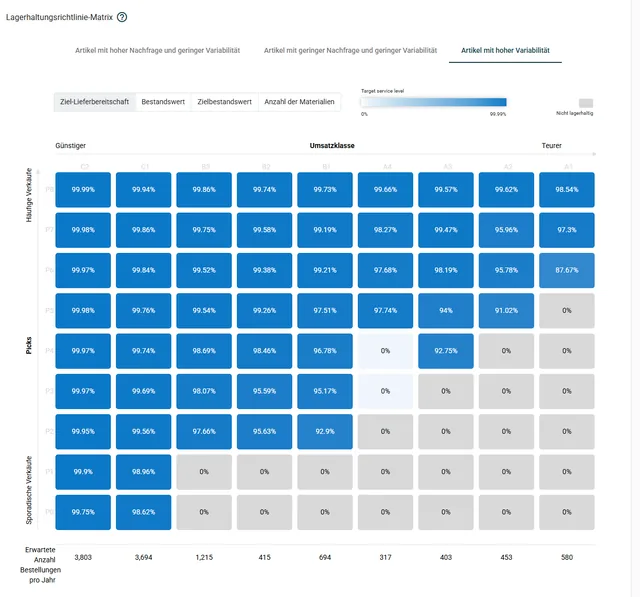
Up-to-date stock parameters.
Safety stock and reorder point per article are recalculated every night, derived from your target service level per article class. Master-data maintenance is gone.
Real forecasts per article.
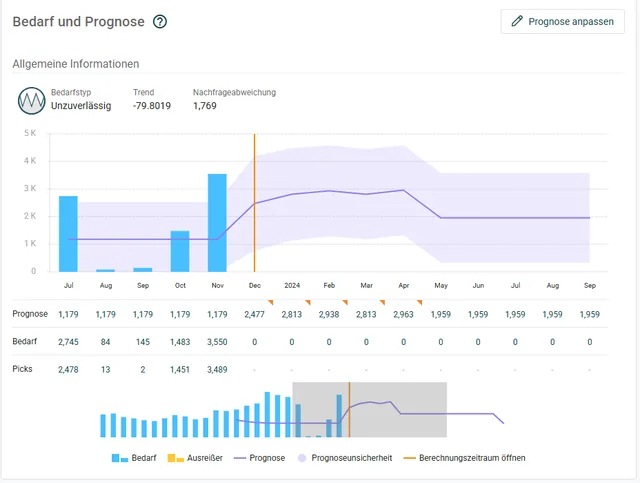
Trend, dispersion, outlier cleansing: EazyStock computes actual demand statistically, article by article. Budgets stay what they are: targets.
Season and lifecycle detected automatically.
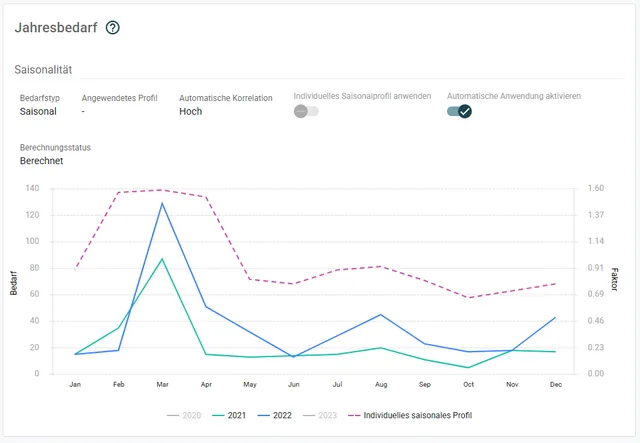
Demand patterns are classified per article, and seasonal curves and lifecycle phases flow directly into the proposals. Without you checking each article individually.
Planned extra demand planned in.
Promotion or project planned? You enter the expected extra demand as a forecast adjustment. The order proposals move with it before the shortage becomes visible.
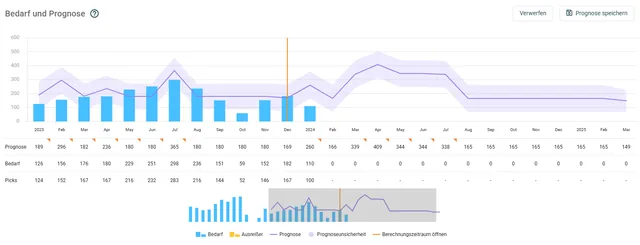
Connected via the OXAS platform.
Opacc provides data and functions centrally through OXAS, and that's exactly what we dock onto. The connector reads at night via the OXAS interfaces and writes approved order proposals back into your procurement.
Enable access
With your Opacc contact you enable read access to articles, warehouses and documents. We supply the list of the required data.
Your effort: approx. 1–2 hours with your Opacc contactMapping and test runs
We configure field mapping, warehouse assignment and business logic and run test runs against your real data until the proposals fit your assortment.
Your effort: a few clarifying questions, no developer neededNightly operation
Every night, articles, demand and orders flow to EazyStock. Approved proposals come back as order proposals into your procurement in the morning.
Your effort: none in regular operationEazyStock computes in your currency, and the warehouse mapping with roles reflects your warehouse structure. A manifest prevents duplicate transactions, even on repeat runs. We monitor the runs, and alerts go to us.
Behind it stands EazyERP, our middleware.
Field mapping to the EazyStock spec, value substitutions, warehouse mapping with roles, a quality gate against the run: what the connector does every night is configured instead of hard-coded, and traceable for every run.
“For part of our range we had to cover warehouse capacity through an external logistics provider. Working with Systempilot let us significantly reduce that and save on storage costs. The support is very comprehensive: for years we've had a fixed point of contact.”

Common questions about Opacc and EazyStock.
How long does connecting Opacc to EazyStock take?
Read access is enabled with your Opacc contact in 1–2 hours. Then come data import, configuration of your business logic and test runs: expect 4–6 weeks to go-live, depending on data quality and assortment.
What do we need to do on our side?
Enable read access via the OXAS interfaces; we supply the list of the required data. You sort that out in 1–2 hours with your Opacc contact. No installation, no developer. We take care of the rest.
Does the system write into our Opacc?
At night the connector only reads. The only thing written back is what your purchasing has approved: order proposals for your procurement. A manifest prevents duplicates, even on repeat runs.
Opacc is announcing AI-supported demand planning. Why EazyStock then?
Good development, and no contradiction. Inventory isn't cut by a forecast alone, but by the method behind it: service-level targets per article class, stocking rules, an operated night run and someone who owns the results. EazyStock has specialised in exactly this problem for over 20 years, and we run it for you.
We compute in CHF. Is that a problem?
No. EazyStock computes in your currency, CHF as well as EUR. Multiple warehouse locations are also reflected by the warehouse mapping. We've worked with Swiss clients like MAX HAURI for years.
What does it cost?
The Opacc connector is part of the EazyStock project, not a separate interface development. Rollout projects start at around €5,000, and licence costs typically start at around €1,000 per month.
Get more out of your procurement in Opacc.
In the intro call we look at your assortment together and tell you honestly whether it pays off for you.
Arrange an intro call →